Why Logistics in Delhi Demands Smarter Traffic & Delivery Planning
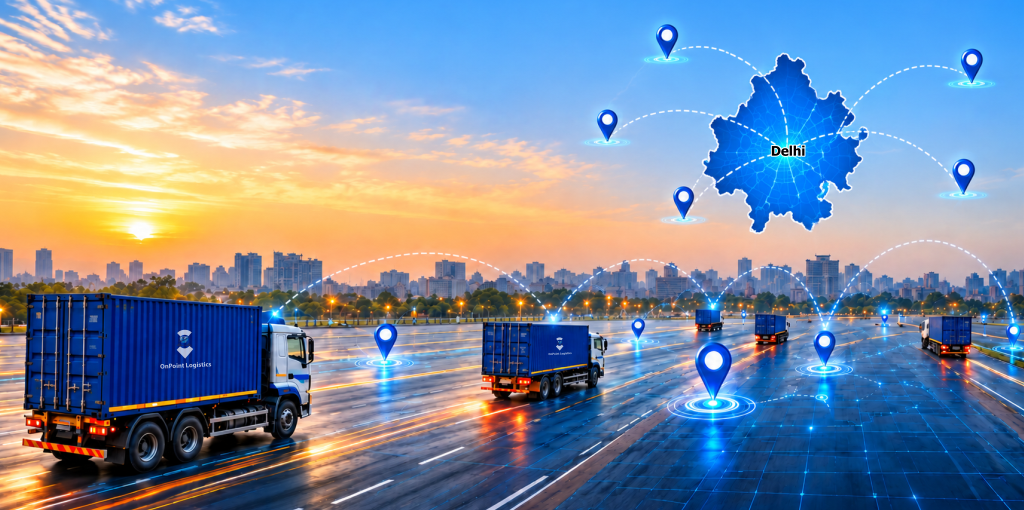
While Delhi is one of many delivery markets that have grown over the past few years, its role as a distribution hub places it within a larger business region, nearby industrial zones, warehouses, distributors, retail outlets, and other cities around the National Capital Region (NCR). That makes daily logistics decisions more dependent on route planning, delivery windows, warehouse location, and coordination than they may appear on paper.
The scale of the logistics ecosystem reflects this demand. As per data from Cushman & Wakefield, 8.7 million sq ft of industrial and logistics leases were signed during the first half of 2026 in Delhi NCR, which accounts for 24% of the total leasing demand from the regions surveyed. Delhi NCR also posted a 69% growth, showcasing the growth in logistics and warehousing operations in the NCR region. National Capital Region itself spans around 55,083 sq. km. in Delhi, Haryana, UP, and Rajasthan. [Source: National Capital Region Planning Board (NCRPB).]
For businesses operating across this region, logistics in Delhi is more than moving a shipment. It requires management of a connected network where traffic, geography, inventory, and delivery expectations all shape the outcome.
Why Logistics in Delhi Requires More Than Just Transportation
Delhi's advantage comes from its position within the NCR. Goods can move from Delhi to other business centers in Haryana, Uttar Pradesh, and Rajasthan, whereas the entire region offers access to highways, industrial areas, warehouses, and big markets.
This presents a chance for firms to cater to several markets using a single connected operational hub. However, simply being well-connected does not ensure easy movement. The very same network that brings connectivity can also present challenges such as congestion, routing problems, loading problems, and even varying delivery conditions.
This is the reason why logistics in Delhi should always take into consideration the whole movement process and not just the distance between two points. Transportation planning needs to consider:
- Pickup and delivery windows
- Traffic conditions and route restrictions
- Vehicle availability
- Warehouse operating hours
- Shipment size and load type
- Customer receiving schedules
- Distance between storage and delivery locations
- Possible delays at multiple points in the journey
This is why freight transportation in Delhi needs to be planned around the entire movement rather than only the driving distance. That brings the focus to the infrastructure supporting the region.
How the Delhi NCR Transportation Network Shapes Freight Movement
As an interconnected economic area, the Delhi NCR transportation network is characterized by a wide-ranging coverage that helps link the entire region and offers accessibility at different points in the region. This includes the roads and rail networks that are regulated by the National Capital Region (NCR) Planning Board, which has historically planned for infrastructure development in response to the demand for increased connectivity between various parts of the region.
The idea behind reducing traffic in Delhi NCR while at the same time improving connectivity outside the city has both merits and demerits for businesses operating in the logistics sector. On one side, businesses have access to different markets from Delhi and its surrounding areas. On the other, a shipment may cross several high-traffic corridors before reaching its final destination.
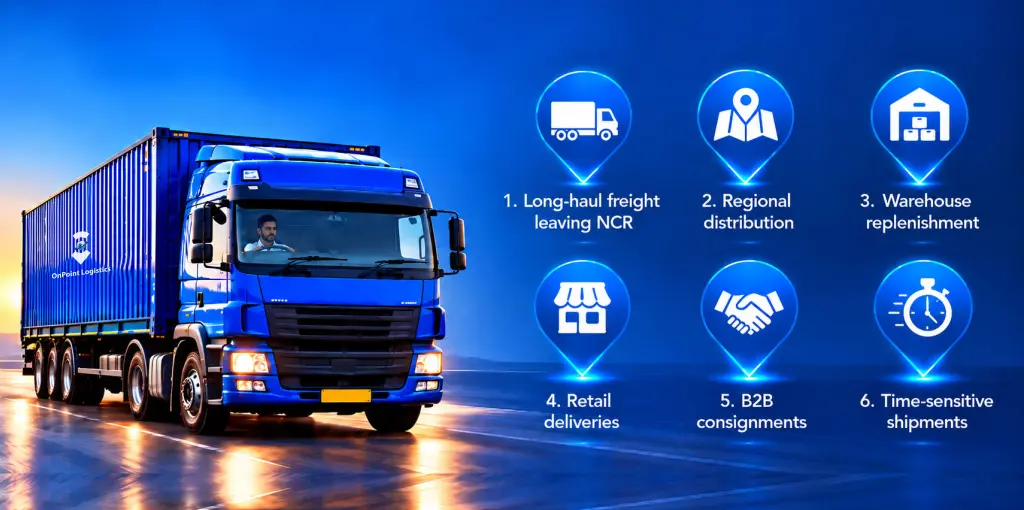
That makes route selection important for:
- Long-haul freight leaving NCR
- Regional distribution
- Warehouse replenishment
- Retail deliveries
- B2B consignments
- Time-sensitive shipments
The practical solution is not to avoid the network. It is to use the network intelligently, choosing the appropriate route, vehicle, and delivery plan for each shipment.
Traffic Is Only One Part of the Logistics Challenge
Certainly, traffic would be one of the most obvious problems, but not the only one. Large-scale logistics challenges in Delhi NCR faced by businesses often arise as a result of several small problems occurring simultaneously. For instance, a delayed pickup would lead to a delay in loading. A delayed departure would disrupt the delivery schedule. If the receiving location has a fixed appointment, then any delay would create additional complications.
For businesses handling regular shipments, these issues can become expensive when they happen repeatedly. Common operational pressure points include:
- Unpredictable travel times during busy periods
- Congestion around major commercial corridors
- Limited delivery windows at certain locations
- Coordination between warehouses and transport teams
- Vehicle scheduling for different shipment sizes
- Last-mile access to individual delivery points
- Maintaining visibility after dispatch
This is the reason why companies working in logistics in Delhi need to look beyond the price of the transport quoted. A low freight rate does not necessarily mean lower logistics cost if repeated delays create additional handling, follow-ups, or missed delivery commitments.
Warehousing Has Become a Bigger Part of Delhi's Logistics Equation
Today, transportation cannot be separated from warehousing anymore. The location of the warehouse becomes a determining factor for the time it takes for the inventory to reach the consumer, distributor, or retailer. This also depends on the distance the vehicles have to cover prior to beginning the actual process of distribution.
The expansion of warehousing in the Delhi NCR region provides an insight into the significance of this relation. For a business, the following evaluation of the warehouse is practical:
- Location and access to major routes
- Storage capacity
- Inventory organization
- Receiving and dispatch processes
- Order handling
- Distribution connectivity
- Tracking and reporting
- Ability to scale during demand fluctuations
This is the stage where the logistics and warehousing services in Delhi become integrated. If there is an effective storage system in the warehouse that leads to an ineffective delivery system, it may not provide the desired advantage to the business.
Why Warehouse Location Matters to Last-Mile Delivery
The final delivery can be the most operationally sensitive part of a shipment. A product may have travelled hundreds of kilometres efficiently, but the last stretch still needs to reach the correct location, at the right time, with the right documentation and receiving coordination.
For businesses operating across Delhi NCR, this can involve deliveries to:
- Retail stores
- Distributors
- Offices
- Industrial facilities
- Customer locations
- Warehouses
- Project sites
The challenge increases when multiple delivery points need to be covered from one warehouse. Instead of treating last-mile delivery as a separate activity, businesses should connect it with inventory planning and dispatch schedules. This can help reduce unnecessary movement and make delivery routes easier to manage.
Choosing the Right Transport Model for Different Shipments
Not every shipment should move in the same way. A business with a large dedicated load may require FTL transportation, while smaller consignments can be better suited to PTL. Urgent shipments may require air transportation, while certain long-distance or bulk movements can make rail a practical option. The decision should consider:
- Shipment volume
- Cargo characteristics
- Required delivery timeline
- Origin and destination
- Cost sensitivity
- Frequency of movement
- Need for dedicated capacity
For businesses managing regular freight transportation in Delhi, having multiple transportation options can make the logistics plan more flexible instead of forcing every shipment into the same model.
Technology Helps Turn a Complex Network Into a More Manageable Operation
Technology cannot remove Delhi traffic; it can certainly help in making the process much easier to track and manage. Real-time shipment tracking can ensure that the business is aware of the location of its cargo rather than being dependent on calls for information regarding its shipment’s whereabouts.
For logistics operations in Delhi, useful technology should support practical decisions such as:
- Where is the shipment?
- Has it left the warehouse?
- Is it moving according to schedule?
- When should the receiving team prepare?
- Has delivery been completed?
- Is an exception developing?
Visibility becomes especially important in case of multiple shipments being transported across different locations in NCR at the same time.
Scheduled and Appointment Deliveries Can Reduce Last-Mile Friction
Some businesses do not simply need a delivery to happen same day; instead, they need it to happen within a specific window. This is common when warehouses, retail outlets, distributors, or business facilities have defined receiving schedules.
Scheduled delivery can help businesses coordinate:
- Dispatch timing
- Vehicle allocation
- Warehouse readiness
- Receiving availability
- Delivery windows
- Shipment notifications
Appointment-based delivery takes the same idea further by aligning transportation with a confirmed receiving slot. For recurring B2B shipments, this approach can make the final stage of logistics in Delhi more predictable because the delivery is planned around the operational requirements of both sides.
What Businesses Should Look for in a Delhi Logistics Partner
The search for top logistics companies in Delhi should not be based only on a list or a quoted freight rate. A more useful approach is to compare the operational capabilities behind the service.
Let’s break down these considerations further:
- Check their transportation flexibility – Can they manage various shipment sizes and transportation requirements? Are they limited to just one type of shipment?
- Ensure regional and national connectivity – A Delhi operation often needs to serve NCR first and then connect with other parts of India. Choose a logistics company that has the right network and planning to make this happen.
- Verify warehousing and inventory support – If storage is part of the requirement, ensure that the logistics company offers services that include inventory management and support, along with dispatch and distribution coordination.
- Track shipment visibility – Tracking shipments shouldn’t just tell about shipment status. It should give you access to relevant information about operations as well.
- Evaluate delivery planning – For shipments coming regularly, does the logistics provider offer scheduled or appointment-based options for making deliveries?
- Determine scalability – Does the logistics partner have the capacity to scale up with higher volumes, additional destinations, or changing business needs without forcing the company to rebuild its logistics setup?
These factors are particularly important because logistics challenges in Delhi NCR rarely come from transportation alone. They usually emerge at the points where transportation, warehousing, inventory, and delivery coordination meet.
How an Integrated Logistics Approach Helps Businesses in Delhi
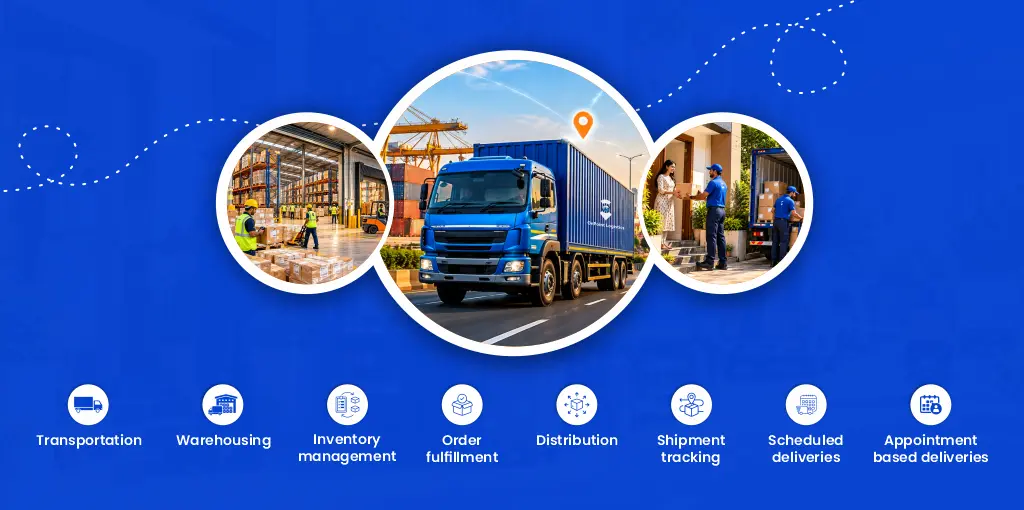
The best method of handling the complexity of markets is by linking the various steps in the shipment process rather than handling them individually. An integrated logistics system will be able to integrate:
- Transportation
- Warehousing
- Inventory management
- Order fulfillment
- Distribution
- Shipment tracking
- Scheduled deliveries
- Appointment-based deliveries
Such a logistics structure is highly useful for small, growing firms since logistical needs change with the increasing shipment volume and delivery points.
Building a More Predictable Logistics Operation in Delhi
Delhi's logistics environment will probably not become easy just because a business raises its transportation budget. The region's scale, the traffic, the connected NCR markets, and the rise in warehousing all demand coordination across the supply chain.
The practical focus should therefore be on predictability rather than speed alone. Businesses can improve their logistics planning by:
- Selecting warehouse locations based on distribution requirements
- Matching transport modes to shipment characteristics
- Planning routes around delivery commitments
- Using real-time shipment visibility
- Coordinating inventory with dispatch schedules
- Using scheduled or appointment deliveries where required
- Working with logistics partners that can scale with business needs
How OnPoint Logistics Supports Businesses in Delhi
For businesses operating in Delhi, dependable logistics means more than simply moving goods from one location to another. OnPoint Logistics supports day-to-day supply chain requirements with transportation, warehousing, fulfillment, scheduled deliveries, and real-time shipment visibility. This integrated approach helps businesses manage movement across Delhi and the wider NCR without relying on disconnected logistics providers.
Its transportation services cover road, air, and rail options, allowing businesses to choose a mode based on shipment type, urgency, and delivery requirements. Warehousing and inventory management further support businesses that need organized storage, order handling, and distribution alongside transportation.
OnPoint also provides scheduled and appointment-based deliveries for shipments that must reach customers, warehouses, or business locations within planned time windows. With tracking and technology-enabled operational visibility, businesses can monitor shipments and respond to changing delivery conditions more effectively.
Conclusion
Perhaps more than the city’s traffic, logistics in Delhi are affected by the NCR corridor, which connects companies to a huge industrial, commercial, and consumer market; growing demand for warehousing is also heightening the importance of storage and distribution decisions. The right approach is to look at the complete movement of goods from inventory and warehousing to transportation, tracking, and last-mile delivery.
OnPoint Logistics supports businesses with road transportation, 3PL and inventory management, scheduled deliveries, and other logistics solutions designed around shipment visibility and operational coordination. For companies that operate regular freight movement in Delhi & NCR, a connected logistics strategy can help them take control of the most critical aspects of their supply chain.
FAQs
1. Why is logistics in Delhi challenging for businesses?
Delhi has heavy traffic, packed neighbourhoods, busy links across the NCR region, and bigger delivery demands. All of this can make route plans harder to set and harder to follow.
2. How does traffic affect freight movement in Delhi?
Traffic can influence transit times, pickup schedules, vehicle utilization, and delivery windows. Businesses can reduce its operational impact through route planning, realistic scheduling, tracking, and proactive communication.
3. What transportation options are available for businesses in Delhi?
Depending on the shipment, companies choose road options, PTL, FTL, rail, or air. The appropriate option depends on cargo size, urgency, destination, and delivery requirements.
4. When should a business consider warehousing in Delhi?
Warehouses help when inventory needs to be closer to buyers. They also help when stock levels are high, when orders must be handled in a smooth way, or when teams need steady distribution to more than one market.
5. How can businesses improve last-mile delivery in Delhi NCR?
They can do this by setting delivery time slots, double-checking delivery address needs, using live updates, lining up receiving times with the buyer, and planning for delays caused by entry rules or traffic.