Warehousing Logistics: Reducing Delays and Controlling Costs
A product rarely moves directly from supplier to customer. Between the two, it may pass through receiving, storage, picking, packing, loading, transportation, and final delivery. Each step requires time, labour, space, and coordination, and inefficiencies at one stage can create additional costs elsewhere.
There is increasing pressure on the Indian logistics industry to ensure fast deliveries while keeping operating expenses under control. In September 2025, the Indian Government published the NCAER Assessment of Logistics Cost in India, commissioned by DPIIT, indicating logistics costs of India to be around 7.97% of GDP using a methodological framework involving both secondary data and national surveys. The figure highlights the importance of improving warehousing, inventory visibility, and transportation coordination alongside delivery performance.
That is why warehousing logistics is about much more than storing products. It connects inventory, warehouse operations, fulfilment, and transportation so goods can move through the supply chain with fewer unnecessary steps.
What Is Warehousing Logistics?
Warehousing logistics is the planning and management of goods as they enter, move through, and leave a warehouse, along with the transportation and information needed to support those movements.
It can include:
- Receiving and checking incoming goods
- Storage and inventory control
- Picking and order preparation
- Packing, labelling and staging
- Loading and dispatch
- Transportation and distribution
- Shipment tracking and delivery confirmation
For a manufacturer, this could mean receiving components, storing finished products, and distributing orders to dealers. For an e-commerce business, it may involve receiving stock, processing individual orders, packing them, and coordinating delivery.
The scope depends on what the business stores, how frequently inventory moves, and where its customers are located.
How Does the Process Work?
In an integrated organization, there exists a process that takes place logically as opposed to thinking of the process of storage and transportation as two separate processes.
- Receiving: Goods are received, checked for any errors, and documented before being stored.
- Put-away: Goods are transferred to their respective storage location based on product type, movement frequency, and other factors.
- Inventory Control: Inventory control involves checking stock levels and the location of goods so that teams know what is available in storage at a certain time whenever an order is placed.
- Picking: Items are picked from storage according to order specifications. This makes it possible to avoid shortages, substitutions, and rework.
- Packing: Products are packed and prepared based on the requirements for handling and delivery.
- Staging: Completed orders are grouped and placed in the right position for shipping. This helps align warehouse operations with the transportation schedule.
- Loading: Shipment is verified and loaded into a suitable mode of transport. Loading depends on the order sequence and handling requirements.
- Transportation: Products are transported using the most suitable mode, whether PTL, FTL, air, or rail, depending on shipment requirements.
- Delivery: The shipment reaches the receiving location, where delivery is completed, and proof of delivery can be recorded.
This is why warehousing logistics cannot be judged only by how quickly a vehicle travels. A truck can complete its route on time while the overall order is still delayed because picking, staging, or loading took too long.
What Services Do Warehousing and Logistics Include?
The exact combination varies by business, but comprehensive warehousing and logistics services can bring several connected activities under one operating model.
These may include:
- Warehousing and storage
- Inventory management
- Order fulfilment
- Packing and dispatch preparation
- PTL and FTL transportation
- Air and rail express movement
- Scheduled and appointment-based delivery
- Shipment tracking and reporting
- 3PL and distribution support
For businesses with several logistics requirements, using connected warehousing and logistics services can reduce the number of separate vendors and handoffs that operations teams have to coordinate.
What Contributes to Warehousing and Logistics Costs?
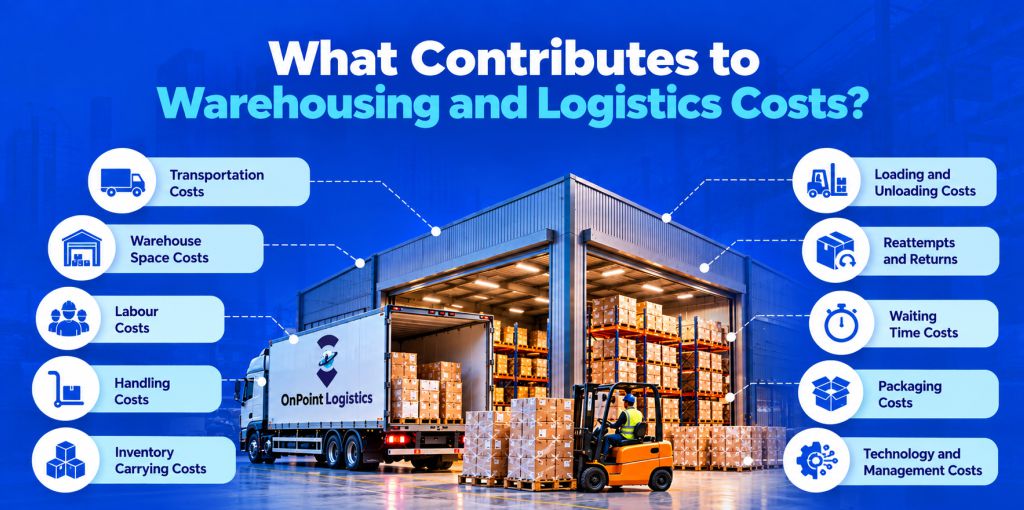
The cost of moving goods is rarely limited to the freight charge. Several expenses can build up before a shipment reaches the road and continue even after it arrives at its destination.
The main cost areas include:
- Transportation: Freight costs vary with distance, shipment size, route, vehicle type, service level, and delivery requirements.
- Warehouse space: Rent, utilities, and the amount of space occupied by inventory contribute to storage costs.
- Labour: Receiving, picking, packing, stock counting, loading, and other warehouse activities require people and time.
- Handling: Unloading, shifting, sorting, re-packing and reloading all add cost when goods have to be moved more than necessary.
- Inventory carrying: Stock held for longer periods ties up working capital and can create additional costs related to storage, insurance, damage or obsolescence.
- Loading and unloading: Poorly planned dock activity can increase labour requirements and vehicle waiting time.
- Reattempts and returns: Failed deliveries, rejected shipments and repeat trips create additional transportation and handling expenses.
- Waiting time: When drivers, vehicles or warehouse teams wait for the next activity, the business is paying for time without moving the shipment forward.
- Packaging: Materials, labour and handling contribute to the cost when products require protective or customised packaging.
- Technology and management: Warehouse systems, tracking, reporting, planning and administrative support also form part of the operating cost.
How Do Operational Inefficiencies Increase These Costs?
Some logistics costs are unavoidable, while others result from operational inefficiencies. A single gap in the process can create additional costs across multiple stages.
The same pattern can occur when:
- Inventory records are inaccurate
- Warehouse layouts create unnecessary movement
- Excess stock occupies valuable space
- Vehicle capacity is poorly utilised
- Products are handled or rehandled unnecessarily
- Warehouse and transport teams are working from different information
- Manual reporting creates repeated follow-ups
- Delivery appointments are missed
Good warehousing logistics therefore focuses on removing avoidable activity rather than simply negotiating a lower freight rate.
What Are the Benefits of an Integrated Approach?
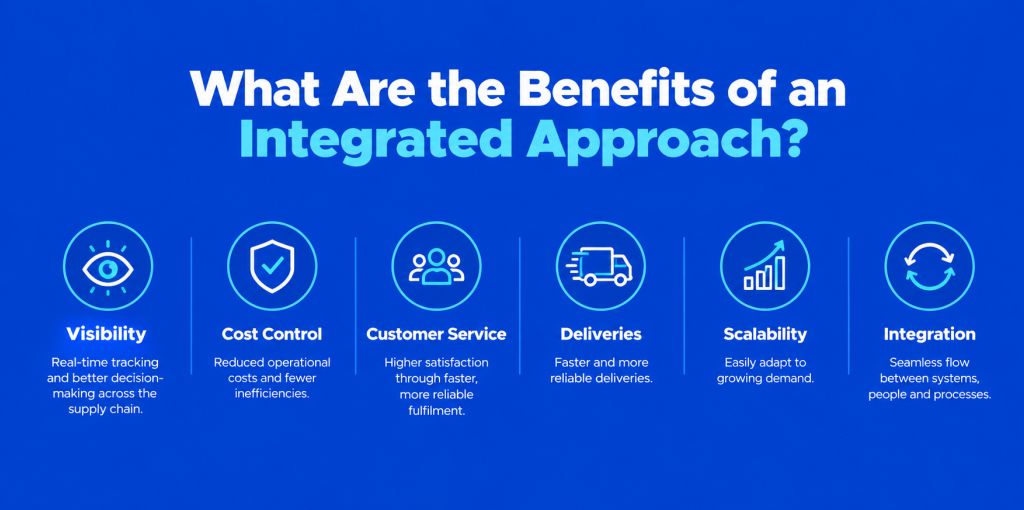
Integrating warehouse management with transportation can give organizations greater control over daily and long-term operations.
The advantages include:
- Visibility- Organizations will be well informed about the movement and availability of their inventory.
- Warehouse performance - Organized stocking, picking, and staging will help to eliminate unnecessary movements and handling.
- Planning for deliveries - Transportation can be coordinated with warehouse readiness and delivery schedules.
- Cost control - By eliminating costs incurred through waiting, rehandling, delivery failures, and excessive inventories, organizations can limit avoidable expenses.
- Customer service - Predictable dispatching and delivery will make it easy to give customers accurate time frames.
- Scalability - An integrated approach will enable organizations to handle an increasing number of shipments without having to develop all logistics capabilities within an organization.
For smaller and growing businesses, warehouse and logistics solutions for SMEs can be useful when internal teams are spending too much time coordinating storage, transport, and inventory separately.
How Do Returns and Reverse Logistics Affect Costs?
Logistics may not always end after delivery because there might be a need to retrieve the returned inventory for inspection, restocking, repair, re-packing, transport, or disposal.
Every additional movement adds transport and handling costs. If returned inventory is not evaluated in time, it can occupy valuable storage space or lose value.
Having a clear process of return helps organizations determine the disposition of items that need to be returned to stock, repaired, rerouted, or taken out of stock.
How Should a Business Choose a Warehousing and Logistics Solution?
The cheapest quotation is not automatically the lowest-cost logistics option. Businesses need to look at the complete operating model and the work included with the quoted price.
Before choosing a provider, consider:
- What products need to be stored?
- How much inventory is held and how frequently does it move?
- Where are suppliers, warehouses, and customers located?
- Are PTL, FTL, air, or rail options required?
- Are scheduled or appointment-based deliveries necessary?
- What level of inventory and shipment visibility is required?
- Can the provider scale as volumes change?
- How are returns, failed deliveries, and other exceptions handled?
- What reporting and operational support will the business receive?
For businesses comparing cost-effective warehousing and logistics solutions, the right comparison is the total cost of running the process, not only the quoted storage or freight rate.
For growing companies, warehouse and logistics solutions for SMEs should also be flexible enough to accommodate changing inventory levels, delivery locations, and shipment volumes.
When Does 3PL Make Sense?
Managing logistics internally can work when volumes and locations are limited. As operations expand, however, businesses may have to coordinate warehouses, transporters, inventory teams, delivery schedules, and reporting across multiple locations.
A 3PL provider can take responsibility for some or all of these activities, depending on the requirement. It can make sense when a business needs:
- Flexible warehouse capacity
- Professional inventory management
- Integrated transportation support
- Order fulfilment and distribution
- Better shipment visibility
- A logistics model that can expand with demand
This approach can also reduce the number of separate logistics relationships that an operations team has to manage.
How OnPoint Logistics Supports the Full Flow
At OnPoint Logistics, we approach warehousing as part of the wider movement of goods rather than as isolated storage. Our services cover warehouse and inventory operations alongside road transportation, PTL, FTL, air and rail express, scheduled delivery, appointment delivery, and 3PL support. Our warehouse and inventory offering also includes warehouse management systems for recording transactions and monitoring warehouse processes.
For businesses that need warehouse inventory management, our connected approach can help align stock movement, fulfilment and transportation rather than managing each activity in isolation.
The practical value is coordination. When inventory information, warehouse readiness and transportation plans are connected, businesses have fewer handoffs to manage and better visibility across the movement of goods.
The Right Solution Starts With the Whole Cost
Storage and transportation decisions affect much more than the freight bill. Space, labour, inventory, handling, packaging, waiting, reattempts and management all contribute to the final cost of getting a product to its destination.
That is why businesses should assess warehousing logistics as a complete operating process. A solution that looks inexpensive at one stage can become costly if it creates extra work somewhere else.
Effective warehouse inventory management can help businesses understand stock movement, avoid unnecessary handling and make better use of available storage capacity.
Ultimately, cost-effective warehousing and logistics solutions are not about choosing the lowest individual price. They are about building a process in which storage, fulfilment, transportation and delivery work together with fewer avoidable costs.
FAQS
1. How does warehousing logistics decrease delivery delays?
Efficient warehousing logistics improves visibility, order preparation, loading coordination, and dispatch planning. This can help businesses reduce unnecessary waiting time before a shipment leaves the warehouse.
2. What should businesses focus on when choosing warehousing and logistics services?
Businesses should consider inventory accuracy, warehousing capacity, transport coverage, traceability, delivery flexibility, and coordination capabilities when choosing warehousing and logistics services.
3. How can warehouse and logistics solutions for SMEs reduce operating costs?
Effective warehouse and logistics solutions for SMEs can help reduce costs caused by excess warehousing, unnecessary handling, delayed dispatches, and poor transportation planning. Scalable solutions can also support better resource allocation as demand changes.
4. Why is warehouse inventory management crucial for fast deliveries?
Effective warehouse inventory management helps businesses track product availability, location, and replenishment needs. Accurate inventory records can reduce picking delays, stock discrepancies, and order delays.
5. How can businesses find cost-effective warehousing and logistics solutions?
Businesses should analyse total operating costs rather than looking only at warehousing or transportation costs when comparing cost-effective warehousing and logistics solutions.