Impact of GST on Logistics and Transportation in India
The logistics industry in India depends heavily on the movement of goods between states, cities, and distribution centres. Since the introduction of the Goods and Services Tax, companies have had to rethink how they handle taxes, how goods move across state borders, and how they manage logistics paperwork.
The impact of GST on logistics goes beyond the tax added to freight invoices. It changes how services are categorized, eligibility for input tax credit, what documents are needed for shipping, and how companies assess their logistics partners. These shifts play an important role in how businesses plan their transportation and supply chain operations. Knowing how GST affects each of these areas helps companies make decisions about moving goods and managing their networks.
What Is GST in Logistics and Transportation?
GST is an indirect tax applied to the supply of goods and services under India's GST framework. In the case of logistics companies, GST is applied through various regulations depending on the type of services provided. The tax is applicable differently for services such as road transport logistics services, goods transport agency (GTA) services, rail transport and freight, courier services, warehousing, and multimodal transport.
The impact of GST on logistics is very important because transportation usually links multiple stages of a transaction. The manufacturer might pay freight charges to move the goods to the warehouse, incur warehouse expenses, and then pay for the shipment of goods to the distributor. Each service may have a different GST treatment and determine the total cost and the paperwork needed.
How GST Has Changed Logistics and Transportation in India
The introduction of GST has brought about a uniform indirect tax system throughout the country, thus minimizing the necessity for various indirect tax authorities in the states. The impact of GST on logistics can be observed in terms of taxation, documentation, and supply-chain planning.
1. More integrated interstate movement
Before GST, businesses that operated across state borders often had to juggle state tax rules and paperwork. GST made it easier by creating an indirect tax system that covers interstate trade.
The e-way bill helps in moving goods by keeping track of required shipment and vehicle information. According to the Government of India's 2026 update on trade efficiency, the number of e-way bills created reached 188.27 crore during the year 2025-26. This is much higher than the 15.74 crore e-way bills created between July 2018 and March 2019.
For businesses, this digital system can improve shipment traceability and reduce dependence on paper-based processes. However, correct documentation and compliance with applicable rules remain essential.
2. Greater importance of warehouse and distribution planning
GST has completely altered how businesses decide where to place warehouses. Now companies can look at storage sites based on how close they are to suppliers, customers, roads, and major distribution hubs instead of only thinking about state taxes.
For example, a company can combine its inventory in a strategically positioned storage facility before sending goods to different cities. The best way to combine the inventory will depend on how customer needs are changing, when deliveries need to arrive, what storage space is needed, and how much transportation will cost.
The impact of GST on logistics is therefore connected to broader supply-chain planning, not just the tax calculation on an individual shipment.
3. More structured tax documentation
GST has increased the importance of accurate invoices, GST identification details, service classifications, and reconciliation between business records and tax returns.
In logistics operations, it is important for companies to make certain that their shipment records, invoices, and e-way bills have the required consistency. Any mistakes could result in delays, compliance issues, or problems with processing payments and tax credits.
How GST Affects Freight Charges and Transportation Costs
GST can affect the final amount a business pays for logistics, but the tax treatment must be assessed according to the actual service and applicable provisions.
GST on road transportation
GST on road transport does not mean a uniform tax rate. As per the provisions of the law on GST, transport services by road are exempt from tax when provided by someone other than a goods transport agency or a courier service company, subject to the applicable exemption provisions.
There are distinctions in the ways in which the GTA services are processed. The GST law provides that a GTA has an option either to pay tax at the rate of 5% without taking input tax credit on relevant input goods and services or opt for the higher rate of 18% subject to all applicable ITC conditions and requirements.
The recipient's status and the nature of the transaction may also determine whether the recipient is liable to pay tax under the reverse charge mechanism (RCM).
Businesses should therefore confirm whether a transport provider is acting as a GTA, whether the supply falls under an exemption, and who is responsible for paying GST. These distinctions matter when comparing freight quotations.
GST on freight charges
GST on freight charges depends on how the service is classified, the applicable rate and any conditions attached to the supply. A freight quotation should clearly identify the service being provided and whether GST is included or charged separately.
Consider a business comparing two freight quotations. One provider quotes a base freight amount, while another provides a quotation that includes applicable taxes. Comparing only the headline amounts may produce a misleading result.
Businesses should compare the total payable amount, applicable tax, eligible ITC and other contractual charges before selecting a provider.
GST on different transport services
GST on transport services varies according to the mode of transportation and the relevant GST entry. For example, qualifying GTA services have specific rate options, while rail transportation and multimodal transportation have their own prescribed treatments.
Under the GST Council's published FAQ guidance, qualifying multimodal transportation is taxed at 5% with restricted ITC where transportation by air is not involved. Where transportation by air is involved, the guidance specifies 18% with full ITC, subject to the relevant provisions.
These distinctions mean businesses should not apply the GTA rate automatically to every freight or logistics invoice. The actual contract and service classification must be reviewed.
Input Tax Credit - An Important Consideration for Businesses
Input tax credit allows eligible registered businesses to offset GST paid on qualifying business purchases against their output tax liability, subject to the applicable conditions and restrictions.
For logistics, this can affect the effective cost of services such as freight, warehousing and handling. However, not every GST payment is automatically eligible for credit. Eligibility depends on factors such as the nature of the supply, the recipient's registration and use of the service, documentation, and applicable restrictions.
For example, a business receiving a qualifying logistics service may need to verify the supplier's invoice, confirm that the tax has been charged correctly, and reconcile the transaction with its purchase and tax records.
The Impact of GST on Logistics can be different for two businesses using similar transportation services if their ITC eligibility differs. Finance and procurement teams should therefore evaluate the tax treatment alongside the quoted service cost.
GST Compliance - What Logistics Businesses Should Manage
Accurate documentation helps businesses avoid preventable disputes and operational interruptions. Key areas include:
- Tax invoice: Check suppliers’ information, description of service, taxable amount, and the tax rates applicable.
- E-way bills: Check if an e-way bill is applicable for the shipment and also verify the rules for issuing the e-way bill, as well as its validity.
- GST classification: Verify if the service is categorized under GTA, road transport, courier service, rail transport, etc.
- Reverse charge: Ascertain whether the supplier or the recipient is responsible for paying GST on that particular transaction.
- Input tax credit: Keep all the records and reconcile your eligible input tax credit.
- Contract clarity: Specify the charges related to freight, handling, warehousing, and other charges in a separate way whenever possible.
These checks become essential for those companies that need to carry out a number of shipments on a frequent basis in different states or those who are dealing with multiple transport providers.
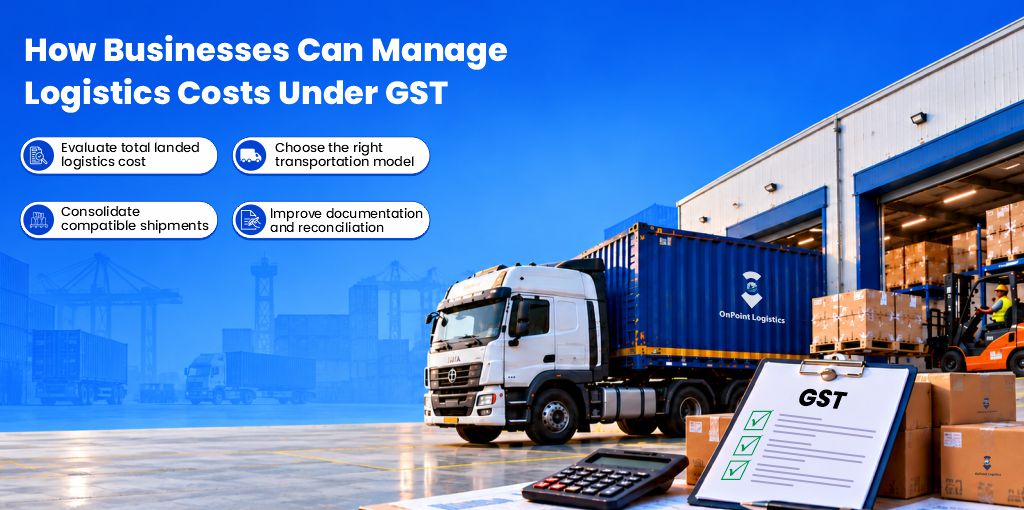
How Businesses Can Manage Logistics Costs Under GST
The practical objective is not simply to minimise tax. It is to understand the complete cost of moving and managing goods while maintaining compliance.
Evaluate total landed logistics cost
Examine the freight costs, GST applicable, whether any ITC credit is available, handling charges, warehousing charges, and other contractual charges. This will provide a better comparison than considering only freight costs.
Choose the right transportation model
PTL will work better for shipments that require a partial truckload, while FTL will work well for bigger shipments where dedicated capacity is justified. Your decision should consider the volume of the shipment, route, timeframes for delivery, and handling operations.
Improve documentation and reconciliation
Standardized invoices, shipment records, and tax checks can help reduce discrepancies and make reconciliation easier.
Consolidate compatible shipments
Where delivery schedules permit, shipment consolidation may increase vehicle utilization and cut unnecessary transport costs. However, the costs of holding inventory and making deliveries must be considered, too.
Review logistics partners on service and cost
When assessing the impact of GST on logistics, businesses should also consider a service provider’s reliability, shipment visibility, delivery performance, and ability to meet their regular operational needs.
For companies seeking affordable logistics services in India, a transparent quotation and a clear explanation of the applicable tax treatment are more useful than a low headline freight rate alone.
How OnPoint Logistics Fits Into Business Transportation Needs
The impact of GST on logistics is not limited to the tax shown on a freight invoice. Businesses also need to consider how transportation choices, warehouse locations, and distribution arrangements affect their overall logistics costs. OnPoint Logistics supports these operational decisions through transportation and supply chain services tailored to different shipment requirements.
For businesses moving goods across cities or states, PTL and FTL transportation provide options based on shipment size and load requirements, while rail and air transportation offer alternatives for specific delivery needs. Selecting an appropriate mode can help businesses assess freight costs alongside delivery timelines, rather than making decisions based on tax rates alone.
Warehousing, inventory management and fulfilment services are relevant when GST-related distribution decisions affect how stock is stored and moved between locations. By coordinating transportation with storage and order fulfilment requirements, businesses can assess their distribution arrangements as a connected process instead of treating each movement as a separate activity.
For businesses reviewing the impact of GST on logistics, the practical priority is to understand both the tax treatment of each service and the operational costs behind moving, storing, and delivering goods. OnPoint’s transportation and supply chain capabilities can support that process by helping businesses organise their logistics requirements around shipment needs and distribution operations.
Managing GST for a More Efficient Logistics Network
The impact of GST on logistics can be seen through the pricing of freight transport, eligibility for tax credits, interstate documentation, and supply-chain management. While GST has indeed managed to bring together an indirect taxation system, the practical application of the same remains dependent on the service rendered and the situation governing the transaction.
These issues can be handled by companies through assessing tax classifications, keeping accurate track of shipments, calculating total logistics costs, and deciding on modes of transport that match their operational requirements.
A clear understanding of GST, combined with careful logistics planning, helps businesses make better-informed decisions about transportation and distribution.
FAQs
1. What is the Impact of GST on Logistics in India?
GST has affected the methods of doing interstate transactions, warehousing, freight taxes, and documentation. The impact of GST varies for every business, and it depends on the logistics services and tax provisions that apply to a particular business.
2. Does the GST Act cover all road transportation services?
When goods transportation by road is supplied by any person who is not a GTA or courier agency, it is not charged under GST. GTA is covered by some special tax provisions under GST.
3. How is GST charged on freight charges?
It will vary depending on the services, applicable GST rates, and conditions. You should be clear about whether the mentioned amount includes the GST or if the applicable input tax credit can be claimed or not.
4. Can input tax credit be claimed by companies on logistics services?
Registered businesses that satisfy the required statutory conditions, without any restriction that stops them from claiming ITC, can claim ITC. The eligibility for claiming ITC needs to be assessed for that particular service.
5. How can companies get affordable logistics services in India
Comparison must be made on the basis of freight, GST, handling charges, warehousing cost, and other costs. Additionally, the suitability of PTL, FTL, or integrated logistics services for the requirement must also be considered.