Beyond Delivery Speed: What Makes B2B Logistics Effective?
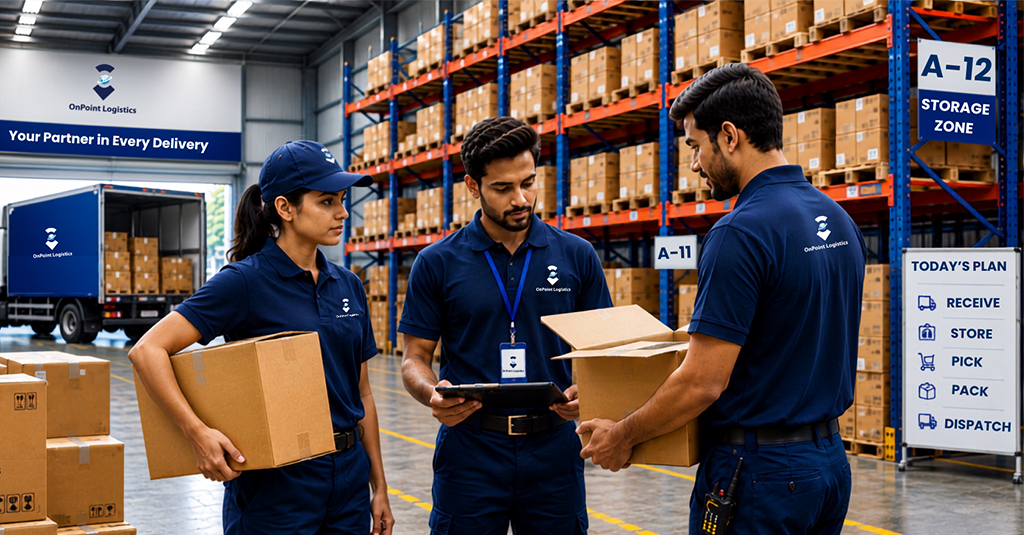
B2B logistics refers to the movement of goods between businesses, including suppliers, manufacturers, retailers, distributors, and other commercial sites. It involves controlling transportation, inventory, delivery schedules, and shipment operations to ensure goods keep moving from point to point in the supply chain.
As freight activity continues to increase, the importance of reliable logistics operations is becoming ever greater. ICRA notes that logistics companies in its sample posted a 11.2% year-on-year revenue growth during 9M FY2026 on medium to high freight volumes. To businesses, this means that B2B logistics needs to offer more than speed. On top of rapid deliveries, businesses now want predictable schedules, greater shipment visibility, and better planning capability to keep their operations running smoothly.
What Is B2B Logistics and How Does It Work?
B2B logistics is the process of transferring goods from one business to another. It involves planning, storing, transporting, and delivering products to suppliers, manufacturers, distributors, wholesalers, retailers, and other commercial destinations. B2B logistics solutions combine these actions to efficiently handle shipments.
What Does B2B Logistics Involve?
- Procurement & sourcing – Moving materials or products from suppliers.
- Warehousing & inventory – Storing and preparing goods for shipment.
- Transportation – Moving goods between business locations based on shipment needs.
- Order fulfillment – Managing orders, schedules, and delivery requirements.
- Tracking & delivery – Monitoring shipments through final delivery.
For example: A manufacturer may source raw materials from multiple suppliers and then ship finished products to different retailers. B2B logistics solutions coordinate the movements of materials and products so they reach where and when they’re needed.
What Makes B2B Logistics Different?
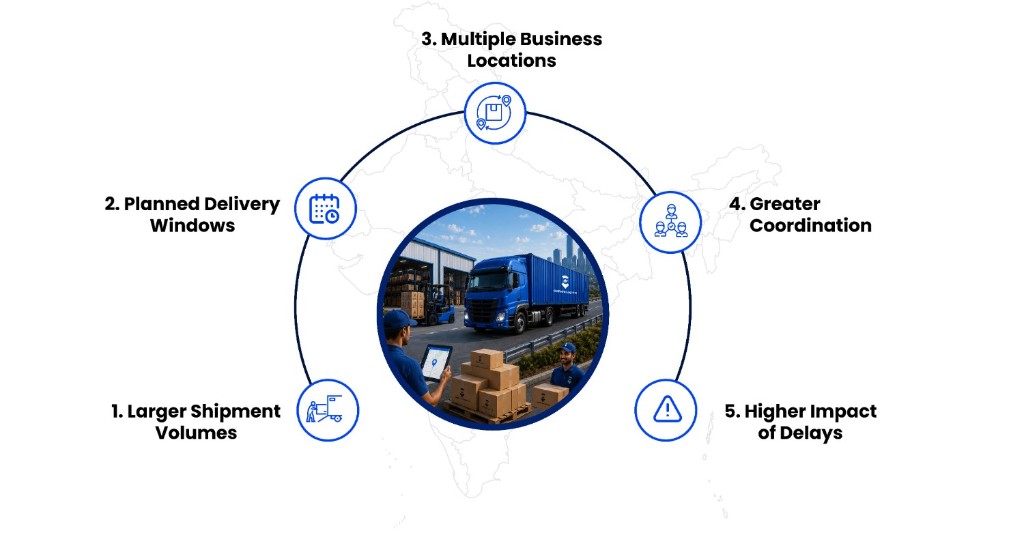
Unlike standard deliveries, B2B operations must account for the special requirements of businesses shipping and receiving goods. B2B operations differ in several ways that directly affect day-to-day logistics:
1. Larger Shipment Volumes
Shipments usually involve commercial loads, pallets, or bulky goods instead of parcels.
2. Planned Delivery Windows
Goods may need to arrive at particular times in order to help with production, to replenish inventories, or for further distribution.
3. Multiple Business Locations
Shipments can be routed among suppliers, manufacturing facilities, warehouses, distribution centers, and retail locations.
4. Greater Coordination
Several parties must coordinate orders, inventory, transportation, documentation, and shipment schedules.
5. Higher Impact of Delays
A missed delivery may impact production, inventory, warehouse operations, or the next stage of distribution.
Why Speed Alone Isn't Enough in B2B Logistics
Delivery time is critical, but speed alone does not measure logistics. Delivery times may differ from one delivery to another and can make it difficult for companies to plan their inventory, production plans, and even warehouse capacity. Even if a delivery is fast, it can still cause operational trouble if it is erratic.
Reliable B2B logistics solutions are designed to make deliveries more predictable and improve visibility and delivery times. It gives businesses the opportunity to plan their inventories better, operate more smoothly, anticipate delays, and give their customers and business partners stronger commitments.
How Technology Makes B2B Logistics More Predictable
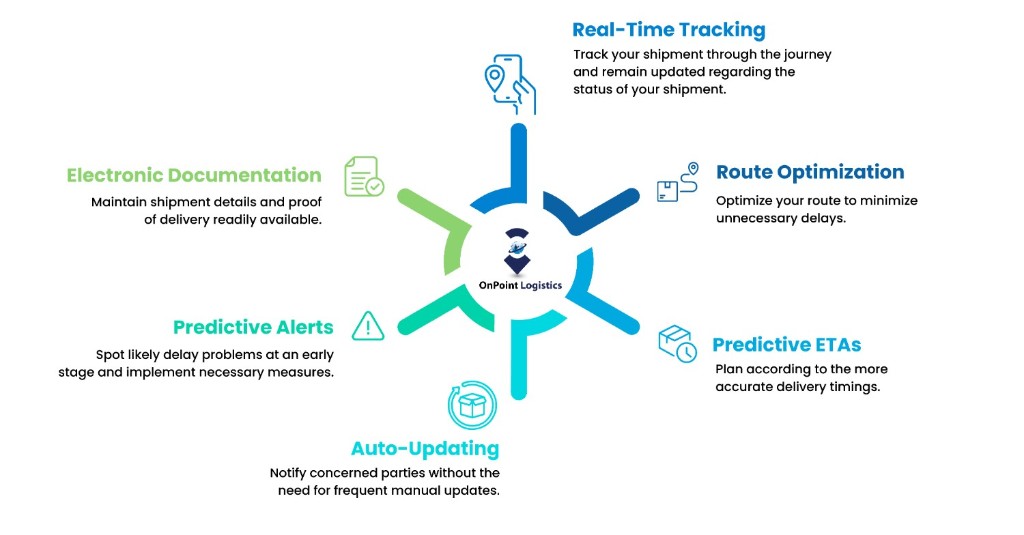
Technology is improving business visibility and control for logistics. B2B logistics solutions are using digital technology to improve shipment planning, tracking, and delivery management for accuracy and responsiveness.
These features are valuable for B2B express logistics solutions, especially when shipments are time-sensitive. Improved visibility and faster alerts enable businesses to respond quickly to changes while keeping delivery plans on track.
B2B Logistics Solutions: What Businesses Need Today
Modern B2B operations require logistics that can keep transportation, inventory, and delivery requirements in sync. The right B2B logistics solutions can align:
- Reliable transportation – Load and transport goods along the stipulated routes and locations.
- Versatile warehousing – Store and manage inventory closer to major markets and operations.
- Coordinated Distribution – Ensure goods circulate efficiently from suppliers to distributors, retailers, and other business locations.
- Shipment Visibility – Receive updates about deliveries and keep track of orders.
- Scalable Support – Support logistics activities to overcome changing shipment volumes and business demands.
For businesses comparing B2B logistics companies in India, these strengths can help evaluate if a vendor can support current needs and future growth. For time-critical deliveries, B2B express logistics solutions can supply quicker shipping choices without compromising shipment monitoring.
When Do B2B Express Logistics Solutions Make Sense?
B2B express logistics solutions are more useful when shipments have to arrive within a shorter time frame. They can be used for time-sensitive inventory replenishment, critical production materials, urgent supply chain, or other urgent deliveries where shipping delays will impact business operations and customer commitments.
Express services offer flexibility over standard delivery timelines for businesses that can be partnered with B2B logistics companies in India. With quicker transport times, shipment visibility, and collaborative delivery planning, companies can focus on essential shipments without disrupting the rest of their logistics operations.
Common B2B Logistics Challenges and How to Address Them
Logistics is prone to delays, capacity constraints, lack of transparency, and unplanned disruptions even when there are multiple shipments, locations, schedules, and several stakeholders involved.
Gartner forecasts that by 2031, about 60% of supply chain disruptions will be fixed automatically without human intervention, underscoring how much automation and real-time analytics will now be required in disruption response.
Overcoming these challenges requires businesses to enhance visibility, flexibility, and communication within their supply chains. B2B logistics solutions can help teams spot problems early, modify delivery plans, and ensure smooth product flows with fewer interruptions.
How to Choose the Right B2B Logistics Partner
Selecting a logistics partner goes beyond analyzing delivery rates and transit times. Companies need to consider the ability of a service provider to manage shipment volumes, make deliveries, offer transparency, and deal with changes in plans.
When evaluating b2b logistics companies in India, consider:
- Network & Coverage – Can the provider reliably serve your key locations and routes?
- Delivery Reliability – Does it consistently meet committed delivery timelines?
- Shipment Visibility – Can your teams track shipments and receive timely updates?
- Scalability – Can the logistics network adapt to changing volumes and business growth?
- Technology & Support – Are tracking, communication, and exception handling built into the service?
You need a partner who meets your operational needs, shipment characteristics, and delivery expectations, not just the cheapest and fastest. That is even more true when businesses need both regular and expedited transportation services.
The Future of B2B Logistics
The next stage of B2B logistics will be all about more connected, predictable, and responsive supply chains. Companies will increasingly use technology to gain greater visibility, anticipate disruptions, coordinate multiple logistics partners, and accelerate decision-making as their logistics become more complex.
- Real-Time Visibility – Live shipment updates for better control.
- AI-Driven Planning – Smarter forecasting, routing, and disruption management.
- Connected Networks – Better coordination between suppliers, carriers, and warehouses.
- Smarter Automation – Faster updates, documentation, and routine decisions.
- Greater Flexibility – Logistics that can adapt to changing business needs.
These advances, when combined, can create a more responsive B2B logistics solution and provide more visibility, flexibility, and control for businesses across their supply chains. This transition will enable logistics to evolve from merely delivering goods into ensuring more dependable and robust business processes.
Conclusion: Building a More Predictable B2B Logistics Network
B2B logistics is not only limited to transporting products between two businesses. Consistent modes of transportation, product tracking, flexible delivery methods, and effective planning are all parts of an effective supply chain that companies can rely on.
OnPoint Logistics enables businesses to make these capabilities a reality with reliable transportation, improved shipment coordination, and logistics support customized to their operational needs. B2B logistics solutions allow businesses to boost the reliability of delivery, respond to changing needs, and bring supply chain control back in their hands.
FAQs
1. What is B2B logistics?
B2B logistics refers to the movement of goods across the business sector, involving suppliers, producers, distributors, wholesalers, and retailers.
2. What are B2B logistics solutions?
They include transportation, shipping, shipment tracking, distribution, and delivery coordination to meet the specific business needs.
3. When are B2B express logistics solutions useful?
They are ideal for time-sensitive, urgent, or production-critical shipments that cannot rely on standard delivery times.
4. How do I choose a B2B logistics company in India?
Search for excellent network coverage, dependable delivery performance, shipment visibility, technology, scalability, and responsive customer support.
5. How does technology improve B2B logistics?
Real-time tracking, route optimization, accurate ETAs, and automated alerts enhance visibility, allowing for a quicker business response.
6. Why does predictability matter in B2B logistics?
Delivery time predictability enables businesses to make informed inventory, operations, and customer commitment decisions and to manage risk arising from delays.