AI in Logistics: From Planning to Delivery
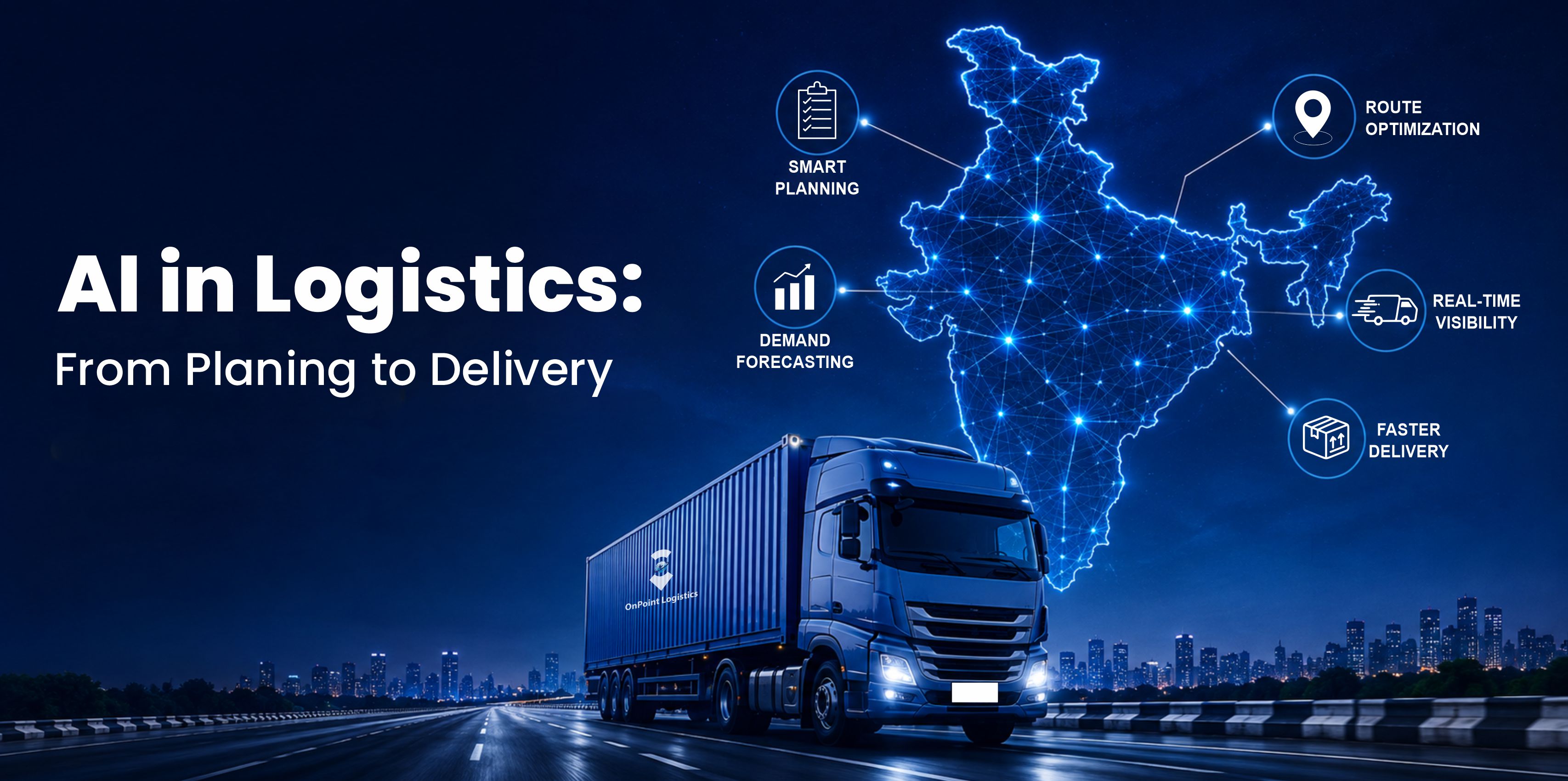
AI is transforming how logistics companies plan freight, manage stock, optimise shipping, and react to disruptions. AI in logistics takes input from operations, shipping, fleets, warehouses, and other sources to find patterns, aid decision-making, and automate tasks that would need far more manual work.
The technology is in the spotlight, but it's not as easy to get it activated as just adding an AI tool onto a current operation. Gartner’s January 2026 study shows that 37% of logistics leaders are having difficulty gaining value from AI as they struggle to become proficient with the technology. The use of AI in logistics and supply chain management can fill this void by being applied to real use cases such as demand planning, transportation, warehouse management, shipment visibility, and exception handling. This guide outlines the role of AI in logistics, details how it can help companies, and examines what they need to know to get started.
Understanding AI in Logistics
Logistics often requires continuous decision-making in the areas of transportation, inventory, warehousing, and delivery. It is increasingly difficult to make decisions based solely on human analysis when shipment volumes are increasing, and the operating environment is becoming more complex.
AI in logistics provides data-driven intelligence by analyzing large amounts of data and using those insights to make faster, smarter decisions. The applications of AI in logistics cover forecasting demand and planning routes to monitoring shipments, managing operations in the warehouse, and identifying potential disruptions before they impact delivery.
Why AI Matters for Modern Logistics
Logistics must maintain a balance between time, cost, inventory, and fluctuating customer demand. With such dynamic parameters becoming increasingly difficult to juggle through manual processes, organizations are increasingly resorting to AI-based solutions.
As AI in logistics industry operations gets smarter, businesses can take advantage of it for planning, disruption forecasting, inventory management, and time-consuming operational tasks. As the role of AI in logistics increases, these abilities will be useful in helping companies transition from being reactive to proactive in their logistics operations.
Where AI Is Making an Impact Across Logistics
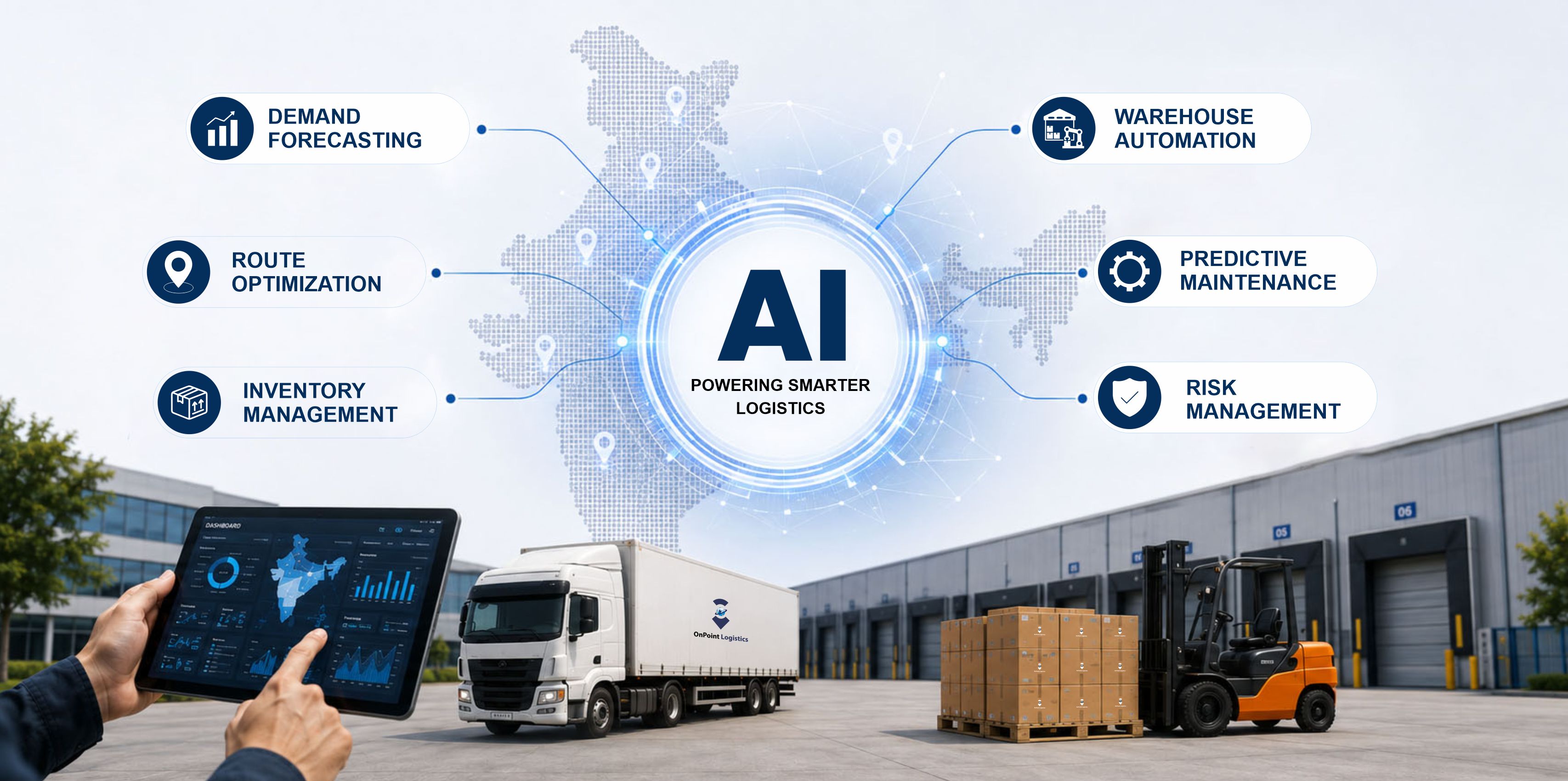
AI is being used in multiple areas of logistics, including demand forecasting and service planning, warehouse logistics, and shipment monitoring. The role of AI in logistics is also growing as organizations increasingly are using these capabilities to make their logistics operations more agile and data-driven.
Demand Forecasting
AI analyzes historic and ongoing data to detect demand trends and assists organizations in managing inventory and transportation better.
Route Optimization
AI in transport logistics can analyse route data, traffic conditions, delivery requirements, and other variables to help to plan transportation more efficiently.
Warehouse Operations
AI can conduct inventory tracking, help plan storage, facilitate order processing, and manage repetitive processes in the warehouse, in turn, boosting efficiency.
Predictive Maintenance
Using vehicle and equipment data, AI can spot indicators of possible failures, alert teams, and prevent disruptions due to required maintenance.
These applications clearly show the decision-making capability of AI in transportation and logistics, which is not restricted to a particular phase of the logistics process but applies to the whole process.
AI-Powered Transportation and Route Planning
Transportation choices usually revolve around traffic, distance, delivery timings, vehicle availability, and varying road conditions. AI in transport logistics is capable of analysing all these aspects at once in order to aid companies in optimizing routes, allocating transportation vehicles appropriately, and responding rapidly to any changes.
AI can also increase delivery predictability through analysing transportation data from the past as well as real-time data to detect any possible delays and calculate delivery times. Vehicle data can be used for predictive maintenance, whereas AI in transportation and logistics can assist in making optimal decisions related to fleet usage and transportation planning.
AI in Warehousing and Inventory Management
Warehousing relies on proper inventory recording, good storage, effective order processing, and having the appropriate stock at the right time. The application of AI in logistics and supply chain management will be able to analyze inventory levels, orders placed, demands, and warehouse activities to enhance stock management.
With the increasing role of AI in logistics, AI can further be used to recognize abnormal inventory trends, forecast replenishment needs, and automate redundant activities within the warehouse. For AI in logistics, these abilities can assist in improving the accuracy of stock, preventing unnecessary delays, and improving warehouse efficiency.
Challenges of Using AI in Logistics
The use of AI will be beneficial to logistics operations; however, implementing it in the present-day systems is not only about incorporating a new layer of technology. It takes dependable data and a professional approach to make it work.
These may prove to be major obstacles. The challenges faced by organizations that use AI in logistics include incomplete data, outdated IT infrastructure, lack of technical skills and experience in scaling up AI initiatives, among others.
Other challenges can include:
- Data quality: The lack of completeness or consistency in data may impact the accuracy of insight generation through AI.
- Integration into the system: It is not an easy task to integrate AI with current TMS, WMS, ERP, and other logistics systems.
- Training and skills: The team should be trained enough to properly interpret AI-generated insights.
- Logistics data security: Security and governance should be addressed in terms of data being moved between connected systems.
- Beyond pilots: Successful use cases of AI should have the proper processes and infrastructure in place.
AI in logistics is thus no longer just about choosing the right technology. What is also required is the data, systems, and processes that can help make use of these capabilities for continuous improvements in operations.
The Future of AI in Logistics
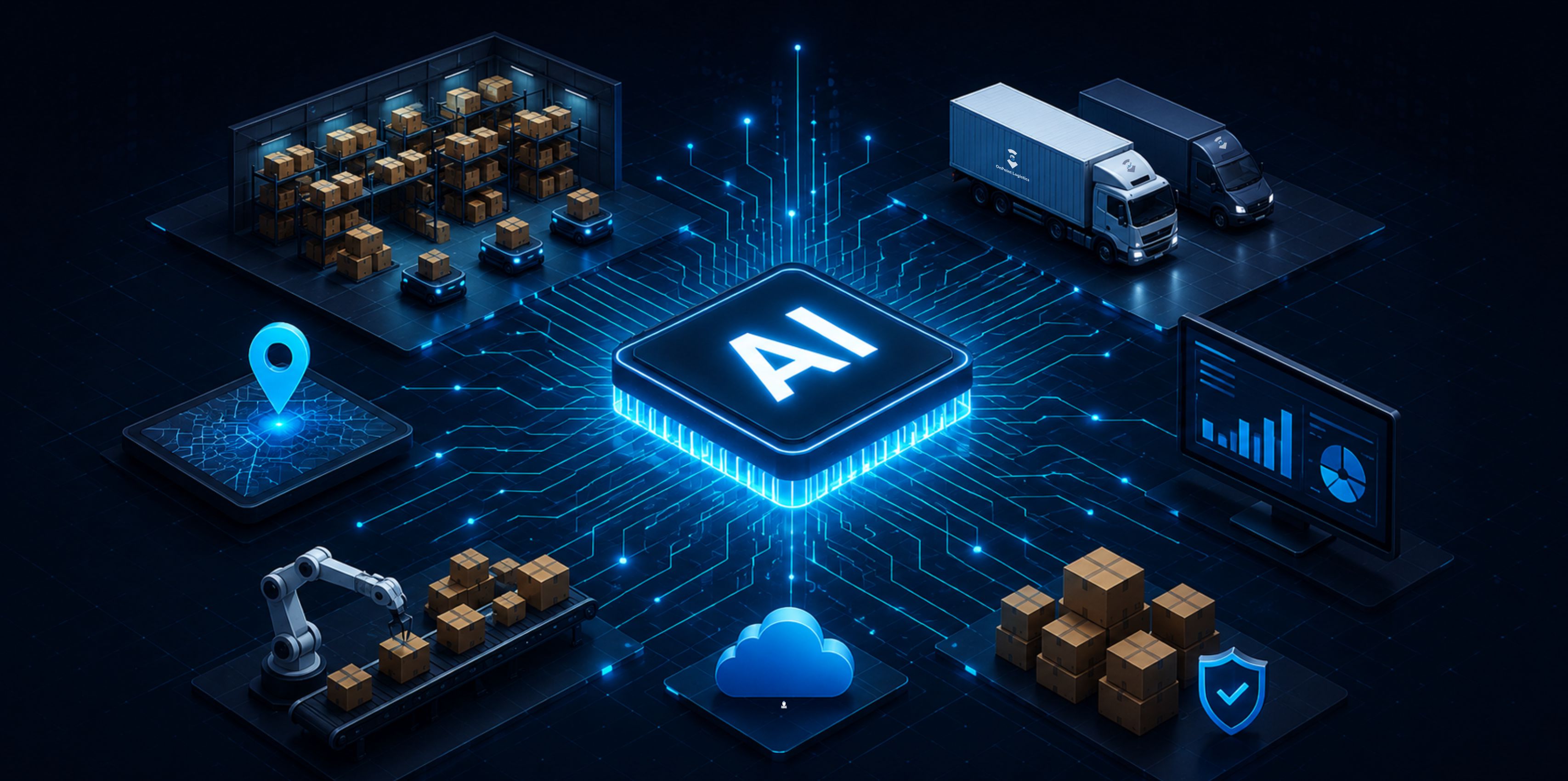
With the advancement of AI technology, it will be used not just for isolated activities but for broader logistics management processes. Companies will find themselves utilizing AI as part of an overall strategy involving planning, coordination, and decision-making.
From Prediction to Action
AI is shifting from analysis of historical data to forecasting demands, detecting disruption, and suggesting appropriate measures.
More Connected Operations
AI can relate all information from transport to warehousing, inventories, and deliveries to make AI in logistics and supply chains more coordinated.
Intelligent Automation
Standard decisions and routine operations can be gradually automated, enabling individuals to concentrate on other tasks.
More Predictive Logistics
The role of AI in logistics will increase even further as companies shift from responding to situations to predicting them in the future.
Conclusion
AI is increasingly making its way into logistics practices that help firms make sound decisions about planning, transportation, warehousing, inventory management, and delivery. In terms of demand forecasting and route optimization, as well as increasing visibility and disruption identification, its importance is in enhancing responsiveness and data-based logistics.
At OnPoint Logistics, we know the value of combining reliable logistics services with the proper technology and visibility. As AI becomes more sophisticated in logistics, these features can be leveraged by organizations to develop more effective supply chains.
FAQs
1. What is AI in logistics?
AI in Logistics involves the use of artificial intelligence technology to analyze logistics information, identify trends, make predictions, and help in decision-making processes in logistics.
2. How is AI used in logistics?
There are numerous roles of AI in logistics which include demand forecasting, routing, tracking shipments, inventory control, warehouses, and predictive maintenance.
3. How does AI improve transportation and route planning?
AI can study traffic information, road information, delivery schedule information, and other transportation-related information in order to determine the optimal route.
4. Can AI help with warehouse and inventory management?
Yes. AI is able to analyze inventory, demand, and movements in the warehouse to provide planning, replenishing, storage, and order processing.
5. What are the challenges of implementing AI in logistics?
Some common problems that arise include data quality issues, systems integration issues, cost concerns related to implementation, lack of technical expertise, data security concerns, and AI scalability issues.
6. What is the future of AI in logistics?
AI is anticipated to become more embedded in logistics activities, assisting in prediction and decision-making through intelligent automation.